





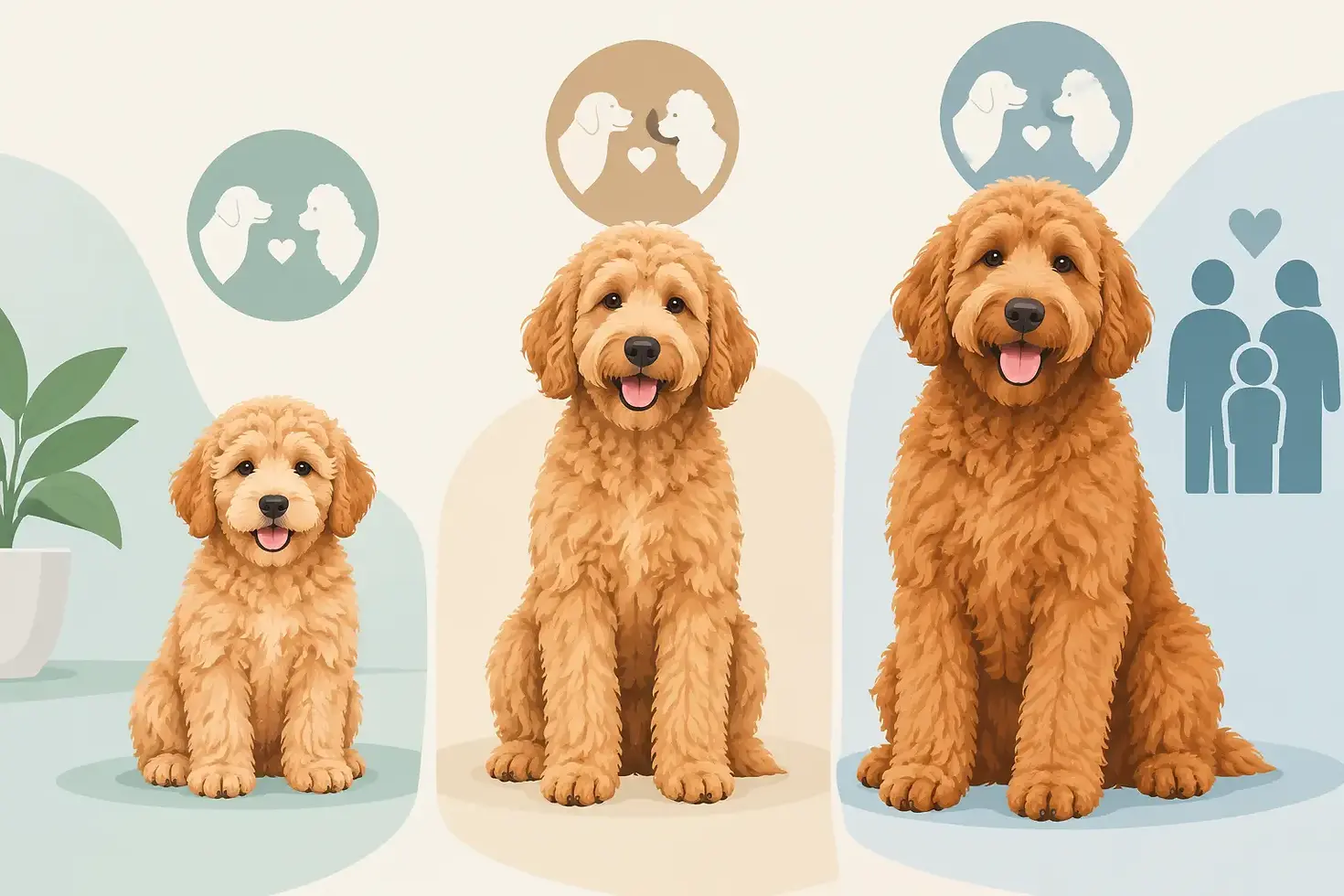
Goldendoodle Generation Comparison for Families
A Goldendoodle puppy may have the soft coat, bright eyes, and affectionate nature your family hopes for, but the letters in front of its generation can still feel confusing. An F1, F1b, or multigen label is not a grade of puppy or a promise of one perfect outcome. This Goldendoodle generation comparison is designed to help families understand what those labels describe, what they cannot predict, and which questions matter most when choosing a lifelong companion.
What Goldendoodle Generation Labels Really Mean
Goldendoodle generations describe a puppy's parentage: how Golden Retriever and Poodle genetics come together in a particular breeding. They can offer useful context for possible coat traits, shedding tendencies, and appearance. They do not, however, guarantee a certain personality, adult size, or allergy-friendly home.
Every puppy is an individual. Littermates can vary in coat texture, curl pattern, color, energy level, and grooming needs, even when they share the same generation label. Thoughtful breeding, health-tested parents, early socialization, and a careful match between puppy and family all play a meaningful role in the dog you bring home.
F1 Goldendoodles
An F1 Goldendoodle is a first-generation cross between a purebred Golden Retriever and a purebred Poodle. Because the parent breeds are different, F1 puppies can show a broad range of coat types. Some have loose waves, some develop a curlier coat, and some have a straighter, shaggy look.
Families often love F1 Goldendoodles for their balanced blend of Golden Retriever warmth and Poodle intelligence. Shedding can range from light to more noticeable, depending largely on the individual coat. If reduced shedding is a top priority, an F1 puppy may be less predictable than a puppy from a backcross or multigenerational pairing.
The benefit of an F1 is variety, but variety is also the trade-off. A responsible breeder should be honest about what can be anticipated from the parents while avoiding promises that genetics cannot support.
F1b Goldendoodles
An F1b Goldendoodle is typically produced by breeding an F1 Goldendoodle back to a Poodle. This pairing generally increases the Poodle influence in the litter. Many F1b puppies have curlier or wavier coats and are often chosen by families seeking a lower-shedding companion.
That does not mean every F1b Goldendoodle has the same coat or that every home with allergies will be comfortable. No dog is truly hypoallergenic, and allergies can be triggered by dander and saliva as well as hair. Spending time around dogs, speaking with your physician or allergist when needed, and discussing coat expectations openly with the breeder are sensible steps.
An F1b coat can also require a stronger grooming commitment. Softer, curlier coats may mat if brushing is delayed, especially behind the ears, under the collar, around the legs, and in friction areas. Regular brushing and a dependable professional grooming schedule help keep the coat comfortable and healthy.
F1bb and Multigenerational Goldendoodles
An F1bb Goldendoodle has an additional Poodle backcross, meaning the puppy has more Poodle lineage than an F1b. These puppies may be more likely to have a curly, fleece, or wool-type coat, although individual results still vary. Their grooming needs are often significant, so families should choose this generation because the dog is a good fit, not only because they hope for less visible shedding.
Multigenerational Goldendoodles are bred from Goldendoodle-to-Goldendoodle pairings over several generations. You may also see the term multigen. These programs can give experienced breeders more opportunity to select intentionally for temperament, coat traits, structure, and size over time.
Still, multigen is not a universal recipe. Breeders may use the term differently, and two multigenerational litters can have very different pedigrees. Ask what generations are behind the parents, what coat traits are present in the family line, and how the breeder evaluates each puppy's likely coat and adult characteristics.
Goldendoodle Generation Comparison: What Matters at Home
The most useful Goldendoodle generation comparison goes beyond a chart. Rather than asking which generation is best, consider what daily life with your dog will look like in your own home.
A family with young children may prioritize a patient, people-oriented puppy with a temperament suited to an active household. A couple in an apartment may focus on expected adult size, exercise routines, and the ability to stay connected through training. Someone with a busy work schedule may need to be especially realistic about grooming appointments, brushing, and the time required for companionship and early training.
Generation can inform the conversation, but it should not replace it. A puppy's individual personality, the parents' temperaments, and early handling are often just as relevant to family fit as the letters in the puppy's name.
Coat and Grooming Expectations
Coat type affects more than shedding. It shapes the care your dog will need throughout life. Wavy coats may be easier for some families to brush, while curly coats can be beautiful and lower shedding but need consistent maintenance to prevent matting.
Ask the breeder to explain the coat types expected from a litter in clear, practical terms. How often should the puppy be brushed? What grooming interval is recommended? Are there coat traits common in the parents or previous litters? Honest answers are more valuable than a broad claim that a puppy will be "non-shedding."
Size Is Determined by More Than Generation
An F1b is not automatically smaller than an F1, and a multigen puppy is not automatically larger or smaller than either. Adult size is influenced by the size and structure of both parents, as well as the broader family line.
This is especially important for families searching for petite miniature or micro-mini Goldendoodles. A responsible breeder should discuss the expected size range based on the specific pairing, not simply the generation label. Even within a thoughtfully planned litter, puppies can mature toward different points within that range.
Health Standards Should Never Be an Afterthought
Generation labels do not replace responsible health testing. A carefully planned breeding program starts with parent dogs that have been evaluated for relevant inherited conditions and selected with health, temperament, and sound structure in mind.
At River Falls Goldendoodles, parent dogs are genetically tested through Paw Print Genetics, and puppies are supported by a two-year health guarantee. Those practices matter because family companions deserve more than attractive coats or trendy labels. They deserve a foundation built on transparency and deliberate care.
When speaking with any breeder, ask about genetic testing, health records, temperament, early socialization, and the support available after your puppy comes home. A breeder who welcomes those questions is helping you make a more informed, confident decision.
How to Choose the Right Generation for Your Family
Start with your priorities, but leave room for flexibility. If lower shedding is high on your list, an F1b, F1bb, or multigenerational puppy may be worth discussing, along with the grooming responsibility that often comes with those coats. If you are drawn to the classic balance of a Golden Retriever and Poodle, an F1 may be a wonderful fit, provided you are comfortable with more coat variation.
Then look at the whole puppy, not just the label. Learn about the parents. Ask about expected size, energy level, coat care, and socialization. Share honest details about children, other pets, activity level, travel, and your experience with dogs. The right match is the puppy whose needs and temperament fit naturally into your family's everyday rhythm.
A generation label can begin the conversation, but a well-bred, well-matched puppy is what turns that conversation into years of muddy paws, couch cuddles, patient greetings, and a companion who truly feels like family.


Comments